
Profiling and Identifying Risk
Problem
A company was relying on clients to complete lengthy free-text forms as its primary means of gathering information. The problem was twofold. First, those forms often sat unreviewed for weeks, meaning high-risk clients were not being identified or responded to in time. Second, the open-ended nature of the responses made them labour-intensive to process, placing a significant burden on staff — and producing little in the way of structured, usable data.
Solution
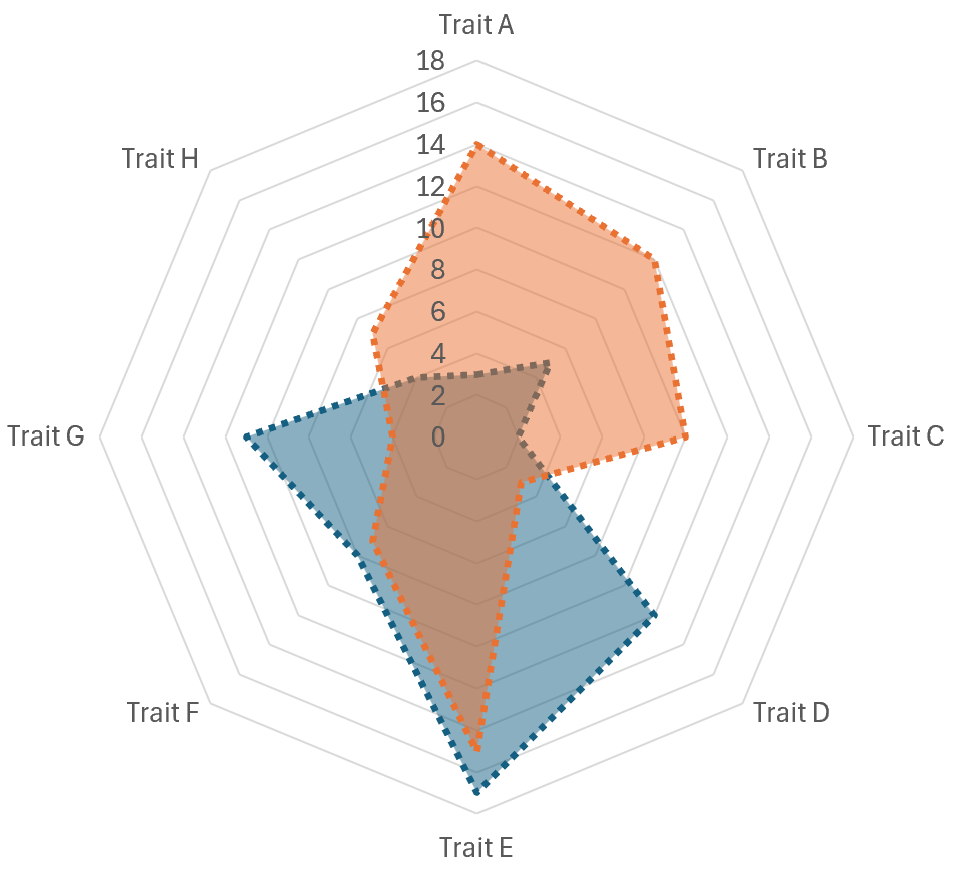
The solution I designed began by mapping a comprehensive and wide-ranging set of typical responses for each form question. When a client submitted their form, the AI assessed each free-text response, identifying statements that matched — or carried the same intent as — the sample responses in the system. It then counted how many responses fell into each category and presented the results as a spider diagram per question.
This visual summary gave staff an at-a-glance view of the form before they read a single word of it. Rather than working through every response sequentially, they could immediately spot patterns and potential red flags, directing their detailed attention to the areas that warranted it. Any high-risk statements were flagged instantly, and relevant staff would be notified automatically.
The system also addressed several other friction points in the process. It evaluated each response for both length and substance, prompting clients to provide more information where answers were insufficient. It identified and corrected instances where clients had entered information in the wrong field. The resulting structured and numerical data derived from the free-text responses were to be made available for downstream use.
Result
The tool was validated as a proof of concept with encouraging results — both in terms of the AI's accuracy in mapping client statements and in how easily staff were able to adopt and apply it. Early estimates suggested it could reduce processing time by as much as 50%, and resolve the risk management issues. The tool is currently awaiting final evals, full build and deployment.